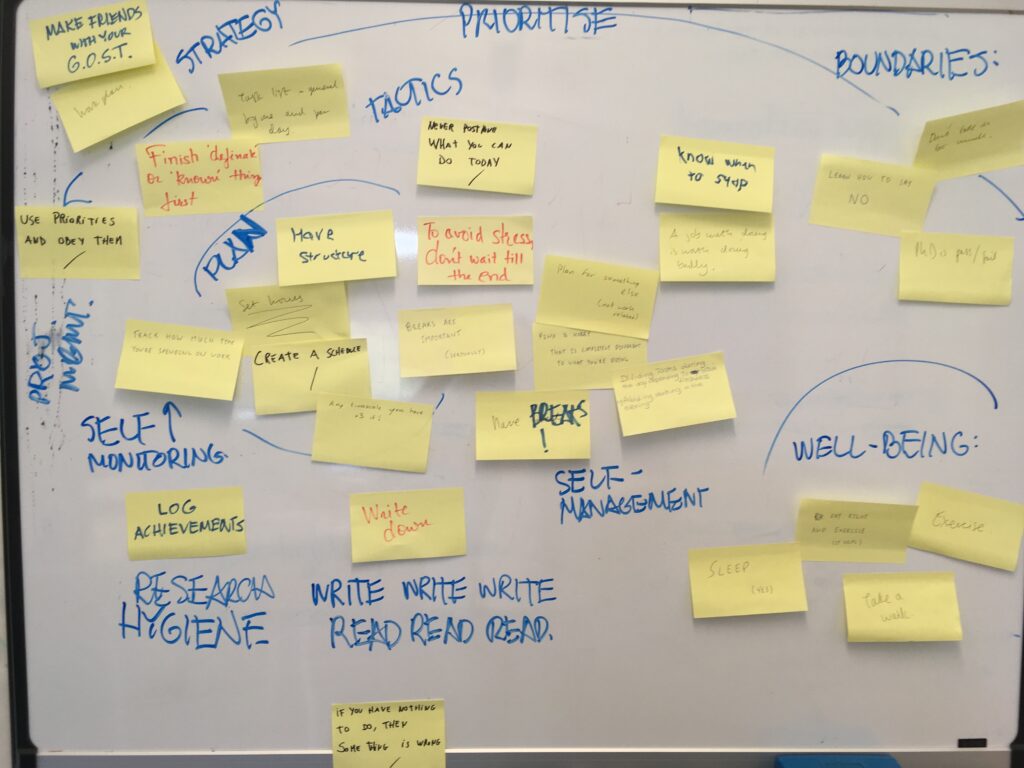
Students ask: How can I manage all the work in time? And how can I balance the PhD with everything else? How do I spread the workload evenly, rather than let it gravitate around deadlines?
When we start a PhD, three (or more) years sounds like a long time. But it isn’t. Most people will experience some life event in that period (e.g., illness, injury, personal loss, change of residence, childbirth …), if not many of them. Even without life events, research can surprise us and throw up unexpected obstacles and opportunities. Many students approach their submission deadline wondering where the time went and how they can finish in time.
I was once asked to intervene with a part-time student who was within 5 months of his registration deadline. After talking with him about the state of his work and whether he had any concerns, I asked him, “Have you tried to project manage your work?” He burst out laughing, and then said, “Do you know what I do for a living?” He was an engineering project manager, but it hadn’t occurred to him to apply that skill set to his own PhD, which he had treated like an open-ended expedition of discovery. We set up a plan that would get him to timely completion, including regular progress reviews with his supervisors, and within 3 months he got in touch to tell me that he’d submitted his dissertation. (There’s a separate blog post on ‘Project Management Essentials’.)
Over the years, mentors and colleagues have offered sage advice about managing workload and the work/life balance:
- You need two passions, and only one can be your PhD. (John Domingue)
- Use your best time of day for your most important work (and save your worst times for ‘housekeeping’). (Alan Blackwel)
- A job worth doing is worth doing badly (i.e., understand what really matters). (TRG Green)
- Plan reading into every day. (Eric Roberts)
- When you’re stuck, take a walk. (Darrell Ince)
- Good designers don’t keep doing what doesn’t work. (Larry Constantine)
- Make friends with your Great Overall Scheme of Things – your GOST. (TRG Green)
Managing your workload is fundamentally about managing yourself. You need to be honest with yourself and use what you know about your habits, your motivations, your fears, your strengths and weaknesses. For example, when as a student I found myself thrashing, I usually shifted to some low-level job that needed doing. That was when I cleaned bathrooms, a job I hated. By the time I’d scrubbed everything to exacting standards, (a) I could check something unpleasant off the ‘to do’ list and hence feel like I’d made progress, and (b) I usually had an insight about something I had overlooked or could change in my research work – and hence start making progress in my research. Later, I learned to use research-related hygiene tasks, such as filing, putting my notes in order, transcribing interviews, running tests, etc. But balancing the PhD with other things, taking time out for the ‘other passion’, can be instrumental to the thinking process, and is essential for our well-being.
One of the key tricks is to align project management with self-management (see the John Domingue advice above). Understand what drives you, and what forces get you to ‘step up’. One such force for many people is external accountability, e.g.: providing weekly updates to supervisors; creating a small network of critical friends and informing them about your deadlines (you can trade favors and hold each other accountable). Another is investing in core needs, e.g., reserving certain time slots for regular exercise, or for your ‘other passion’. Another is rewards: e.g., even something as simple as lining up your favorite cookies, and allowing yourself one cookie for each drafted section of that paper you’re trying to write. One factor that people often overlook is forgiveness. Sometimes we need to step back from striving for perfection to just make – and recognize – some progress (see the TRG Green advice above). And sometimes, rather than wasting energy over a missed deadline, we just need to forgive ourselves, revise the plan, and move on.
External deadlines (e.g., conference or journal submissions, progress reporting, seminar dates) can be great targets and motivators; but they can also become oppressive. The trick to managing them is twofold: look bigger, and look smaller.
Bigger: Consider external deadlines in terms of how they will serve the bigger picture and the ultimate goal (the PhD) – what Thomas Green called the Great Overall Scheme of Things. Consider them also in terms of how they align (or conflict) with other targets and other constraints. Sometimes external deadlines are instrumental opportunities that promote progress on the PhD – but sometimes they are distractions.
Smaller: Decompose the workload into smaller tasks and shorter, achievable deadlines – and schedule those tasks.
And plan in a contingency allowance (e.g., add 20% to the time you plan for a task).
Managing research effectively requires regular review and adjustment to deal with ‘what arises’. The reality is that research often doesn’t go as planned – even ‘Eureka moments’ require adjustment. Project management is a tool to help us maintain progress, so that, even if the destination alters, or some of the planned work is not completed, what has been done is ‘enough’ and lays the foundation for future research.